
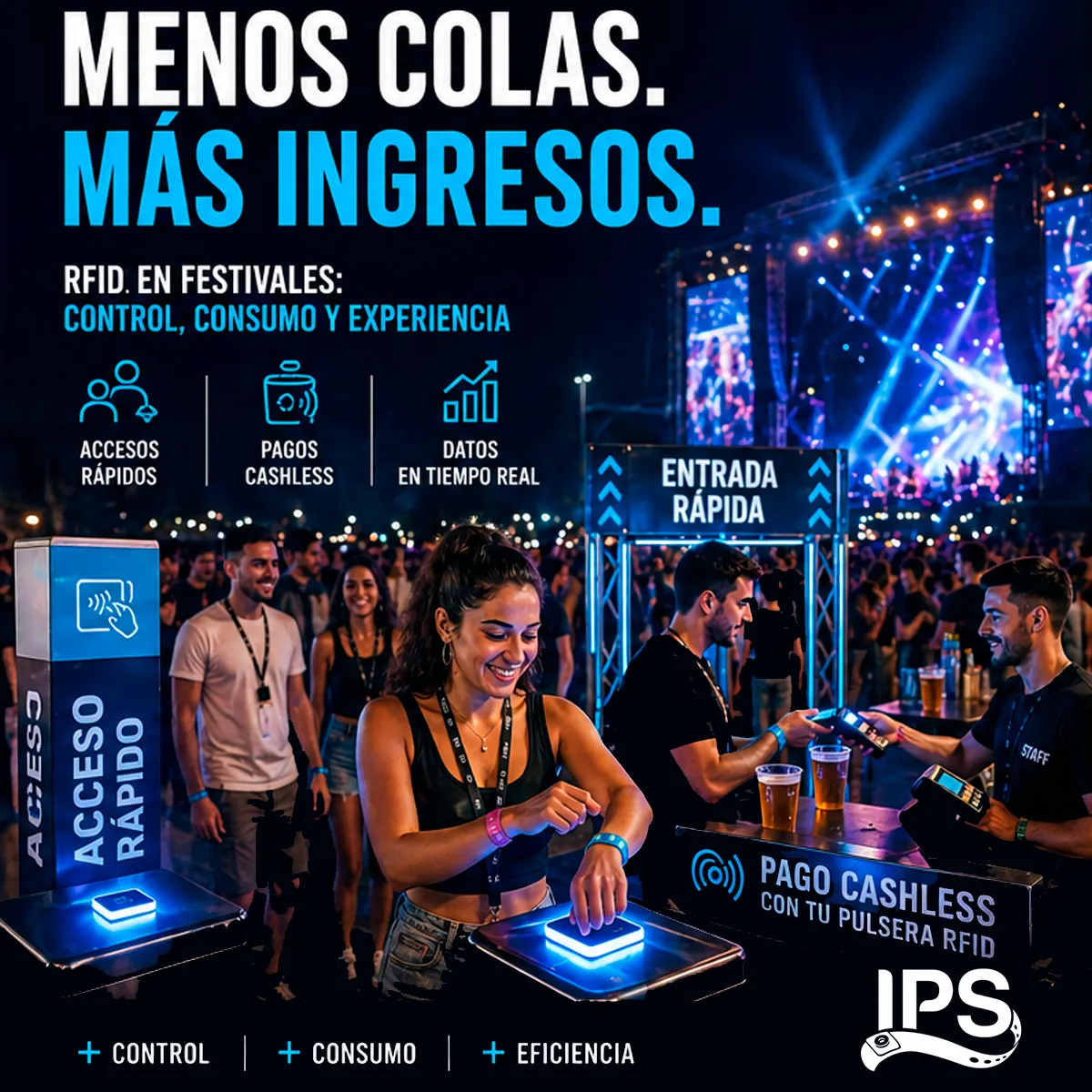
The 2026 festival season confirms an obvious reality: organizing an event no longer consists solely of selling tickets and programming a good line-up. Audience experience, security, smooth access, payment management and operational control have become decisive factors.
In this context, RFID technology has stopped being an innovative solution to become a strategic tool for festivals, concerts, mass events and temporary venues.
For organizers, the question is no longer whether implementing RFID is worthwhile. The question is when to do it, how to integrate it correctly and what impact it can have on the event's profitability.
What is changing in festivals
Festivals no longer compete solely on the line-up. They compete on the complete attendee experience.
An audience accustomed to digital processes, fast payments and smooth access expects the event to run friction-free from the first contact with the venue. When that doesn't happen, the impact is immediate: queues, congestion, complaints, lost spending and damage to reputation.
The main operational challenges remain:
- Queues at entrances and bars.
- Real-time capacity control.
- Fast and secure payment management.
- Fraud reduction.
- Control of VIP, staff, press or backstage areas.
- Security and traceability throughout the event.
At medium and large events, these problems are not minor. A poorly managed queue not only affects the user experience. It can also become a direct loss of revenue at bars, merchandising and commercial activations.
What RFID technology really delivers
RFID wristbands make it possible to centralize several functions in a single physical, comfortable and customizable medium.
A single wristband can be used for:
- Venue access.
- Attendee identification.
- Zone control.
- Cashless payments.
- Capacity management.
- Validation of special profiles: VIP, staff, press, suppliers or artists.
The result is far more agile operations. The attendee doesn't need to carry a printed ticket, cash, tokens or additional accreditations. The organization, in turn, gains control over what happens at every critical point of the event.
The operational impact is usually noticeable in four key areas:
- Reduced access times.
- Elimination or reduction of cash use.
- Greater control over movements and permissions.
- Improvement of the overall attendee experience.
RFID and cashless: less friction, more spending
One of the most relevant uses of RFID at festivals is integration with cashless payment systems.
Instead of paying with cash, card or tokens, the attendee uses their RFID wristband to spend at bars, food trucks, merchandising or designated areas. This reduces transaction time and enables a much smoother purchasing experience.
For the organization, the benefit is not only in convenience. It's in the business.
When payment is faster, bars serve more people in less time. When queues are reduced, lost spending opportunities are reduced too. And when every operation is recorded, the event gains useful information to analyze sales, peak activity times and the audience's actual behavior.
Put simply:
less friction = more potential spending = greater operational efficiency.
Strategic benefits that make the difference
1. Data-driven decisions
RFID makes it possible to move from intuition to measurement.
With proper implementation, the organization can analyze:
- Which entrances concentrate the most flow.
- Which zones have the highest activity.
- At what times spending peaks occur.
- Which points of sale perform best.
- How certain attendee profiles behave.
This information is especially useful for planning future editions, redistributing resources and improving the event's profitability.
2. A better attendee experience
A festival experience begins before the first concert.
If the attendee enters quickly, pays easily and moves around the venue without unnecessary blockages, the overall perception of the event improves.
RFID helps to:
- Reduce queues.
- Speed up access.
- Avoid losses of physical tickets.
- Simplify payments.
- Facilitate access to special areas.
- Improve the sense of control and security.
A good experience not only generates satisfaction. It also encourages repeat attendance, recommendation and the event's digital reputation.
3. Greater control and security
At festivals with thousands of attendees, access control cannot depend solely on manual checks.
RFID wristbands make it possible to validate permissions in real time and segment access by zone:
- General public.
- VIP.
- Staff.
- Press.
- Backstage.
- Suppliers.
- Artists.
- Security.
This reduces the risk of unauthorized access, improves traceability and enables a faster response to incidents.
4. New opportunities for sponsors
RFID can also increase the commercial value of the event.
Sponsor brands increasingly seek measurable activations, not just visual presence. RFID technology makes it possible to develop interactive experiences, participation dynamics, prize draws, access control to brand areas and engagement measurement.
This turns the wristband into something more than an identifier: it can be a brand medium, an activation tool and a data source to demonstrate results.
5. Operational sustainability
Sustainability at events no longer depends solely on eliminating plastics or managing waste. It also has to do with reducing unnecessary processes.
RFID can help to:
- Reduce paper.
- Decrease the use of physical tickets.
- Limit the use of cash.
- Improve resource planning.
- Use more durable or reusable materials depending on the type of event.
For festivals seeking to professionalize their management, sustainability must be part of operational efficiency.
What comes next: from RFID to the smart event
The sector's evolution points toward events that are increasingly connected, measurable and automated.
RFID is a foundation on which more advanced solutions can be built:
- Flow analytics.
- Prediction of congestion points.
- Operational alerts.
- Integration with ticketing systems.
- Audience segmentation.
- Personalized activations.
- Reports for sponsors and promoters.
The future of the festival will not just be more digital. It will be smarter, more measurable and more efficient.
Is implementing RFID at a festival profitable?
Profitability depends on the format, capacity and operating model of the event.
At small festivals, it may be enough to use simpler control systems. But at medium and large events, especially from several thousand attendees onward, RFID can become a key tool to improve efficiency and reduce losses.
For events of between 5,000 and 10,000 attendees, the return usually comes from three main areas:
- Greater spending at bars and points of sale.
- Fewer operational incidents.
- Better use of staff and resources.
That's why, before implementing RFID, it's worth analyzing:
- Number of attendees.
- Access points.
- Expected spending volume.
- Differentiated zones.
- Security needs.
- Integration with payment systems.
- Available staff.
- The event's commercial objectives.
The key is not only in choosing an RFID wristband. It's in designing the complete system well.
Conclusion
The festival sector has changed. Professionalization no longer affects only the artistic production, but also the operational management of the event.
Festivals that still operate with traditional systems can lose efficiency, control capacity and revenue opportunities.
In 2026, the difference is not only in the line-up. It's in the ability to offer a smooth, secure and profitable experience from the moment the attendee arrives at the venue until they leave the event.
RFID technology does not replace good organization. It empowers it.
Are you organizing a festival or event?
At IPS we develop RFID solutions tailored to each type of event:
- Custom RFID wristbands.
- Wristbands for festivals and events.
- Access control systems.
- Solutions for attendee identification.
- Integration with cashless systems.
Request information or a no-obligation quote and we'll help you choose the most suitable solution for your event.