
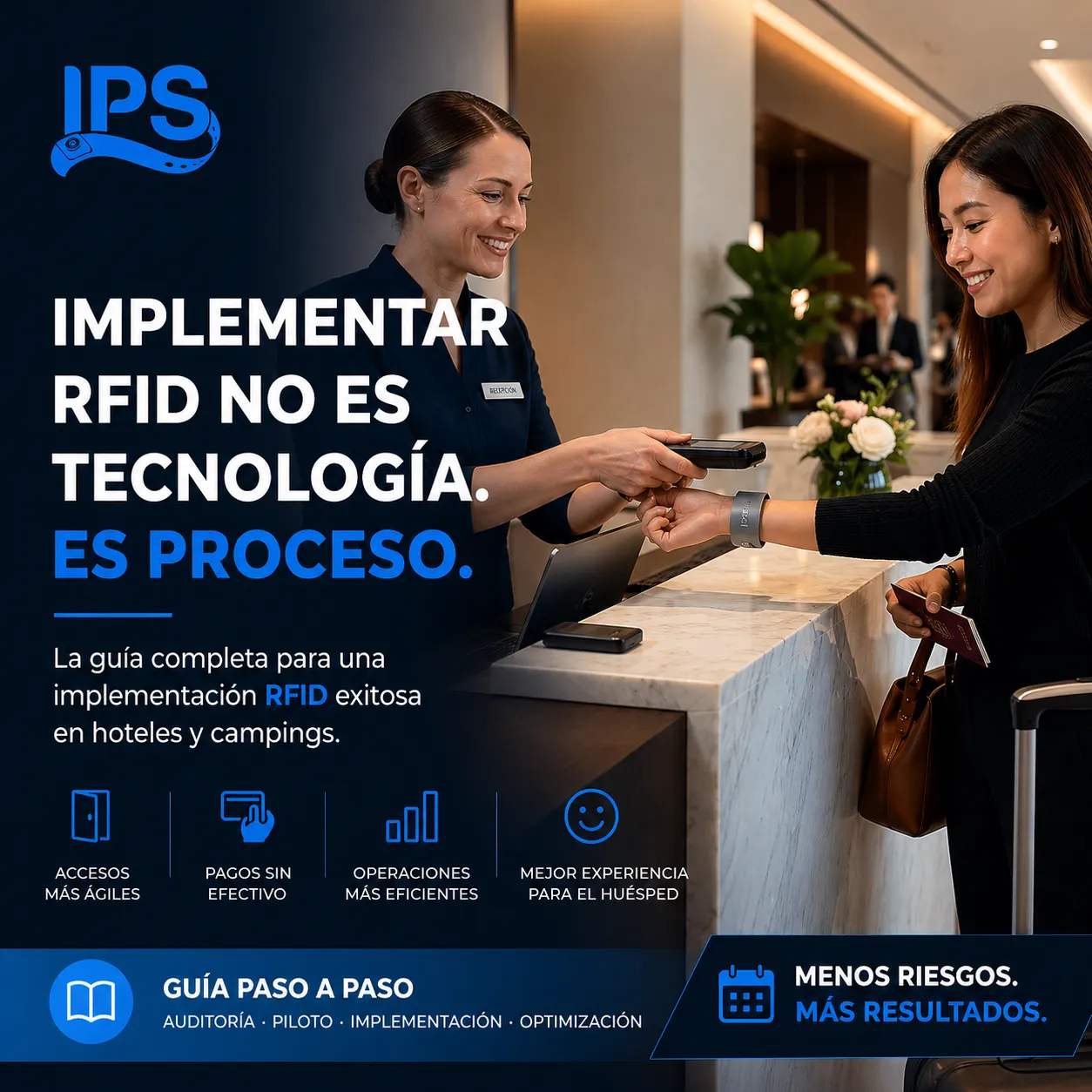
From decision to execution
Implementing an RFID system in hotels and campsites is no longer just a matter of innovation. Today it is, above all, a decision about operational efficiency.
More and more establishments are adopting this technology to simplify access, improve the guest experience and optimize internal processes. However, the success of the project does not depend solely on the technology chosen.
It depends on how it is rolled out.
At IPS we have spent years supporting this kind of process. And there is a clear pattern: when the implementation is planned well, the system improves day-to-day operations. When it is improvised, it can create friction, cost overruns and internal resistance.
That is why, before taking the step, it is worth understanding what implementing RFID in a hotel or campsite really involves.
Before you start: understand what you already have
The first step is not to buy RFID wristbands, locks or readers. The first step is to analyze the establishment's current situation.
Many projects fail because they start from an incorrect assumption: thinking that everything is compatible.
In practice, that is not always the case. Old locks, PMS systems without integration, disconnected points of sale or weak infrastructures can completely condition the implementation.
That is why a prior audit is key. It allows you to detect technical limitations, assess real needs and avoid decisions that, in the medium term, can turn out far more expensive than the initial investment itself.
Defining the scope: start with the essentials
One of the most common mistakes is trying to implement everything from day one.
Access, rooms, internal payments, food service, spa, pools, VIP areas, lockers, time tracking… RFID technology allows for many possibilities. But it is not always advisable to activate them all at the same time.
In hotels and campsites, it is usually more effective to start with a functional, well-defined system. For example:
- Access control.
- Guest identification.
- Key areas of the establishment.
- Priority internal services.
Afterwards, the system can grow progressively.
This approach reduces risks, makes adoption by the team easier and allows you to verify the real impact before scaling the project.
Choosing the right RFID technology
Choosing the technology is one of the most important decisions in the process.
Not all RFID wristbands work the same. Nor are all systems compatible with each other. That is why the decision should not be based only on price or aesthetics.
It must respond to several factors:
- Type of establishment.
- Average length of stay.
- Guest profile.
- Volume of users.
- Available internal services.
- Required level of integration.
- Operational objectives of the project.
A poor choice at this stage can condition the entire system. That is why it is important to work with stable, compatible and scalable RFID solutions.
In the case of hotels and campsites, the technology must be ready to withstand intensive use, adapt to different environments and work reliably throughout the customer's stay.
The pilot: the phase that prevents bigger problems
Rolling out the system directly across the entire hotel or campsite may seem faster. However, it also increases the risk.
A controlled pilot allows you to test the technology under real conditions before scaling it to the whole establishment.
This phase helps detect incidents, adjust processes and check how the team responds. It also allows you to validate the guest experience without compromising the entire operation.
The pilot can be applied to a specific area, a group of rooms, a pool, a food service area or a part of the campsite.
What matters is that it serves to learn before deploying the complete system.
Training and internal adoption
The technology may be well designed, but if the team does not understand it, the project becomes complicated.
RFID implementation changes daily routines, especially at reception, access control, food service and points of sale. That is why training should not be treated as an add-on.
It must be a central part of the project.
Staff need to know how the system works, what to do in case of an incident and how to explain the change to the guest. When the team trusts the tool, adoption is much faster.
By contrast, when there is not enough training, any small problem multiplies.
Going live: the most delicate moment
Going live is one of the critical moments of the project.
During the first days, it is essential to support the client, review the system's behavior and adjust the necessary details. It is also advisable to communicate the change well, both to the internal team and to the guests.
An RFID implementation does not end when the technology is installed. In reality, it begins when the system comes into operation.
From that moment on, the real benefits appear:
- Greater speed at access points.
- Fewer operational errors.
- Better guest identification.
- More comfort for the customer.
- More orderly internal processes.
- Greater control over the establishment's services and areas.
Investment and return of an RFID system
The investment in an RFID system depends on the size of the hotel or campsite, the scope of the project and the level of integration required.
Implementing RFID only for identification and access is not the same as integrating it with internal payments, PMS, points of sale or electronic locks.
Even so, in many projects the return can arrive within a reasonable timeframe when the implementation is well planned.
The main drivers of return tend to be:
- Reduction of errors.
- Time savings in internal processes.
- Greater operational control.
- Increased spending on the establishment's services.
- Improvement of the guest experience.
- Less dependence on manual processes.
That is why the investment should not be analyzed only as a technological cost. It should be valued as a structural improvement in the business's operations.
Common mistakes when implementing RFID
Although every project is different, there are mistakes that recur frequently.
One of the most important is not analyzing the existing system beforehand. Without that review, incompatibilities can appear once the project has begun.
Another common mistake is implementing the system at the peak of high season. At that moment, any incident has greater impact and the team works under more pressure.
It is also frequent to skip the pilot or to train staff insufficiently. Both decisions tend to generate avoidable problems.
The most common mistakes are:
- Not carrying out a prior audit.
- Choosing technology without assessing compatibilities.
- Trying to implement too many functions from the start.
- Not running a pilot test.
- Activating the system in high season.
- Not training the team properly.
- Not communicating the change well to the guest.
- Not having technical support during go-live.
Avoiding these mistakes is not complex. But it requires planning, method and experience.
More than technology: an operational transformation
An RFID system is not just hardware, software or identification wristbands.
It is an operational transformation.
It involves integrating systems, redefining processes, training the team and adapting the customer experience. That is why working with a specialized partner is no minor matter.
It is a guarantee that the project will be carried out correctly.
At IPS we approach each implementation from that perspective. It is not only about supplying technology, but about ensuring that the system works from day one and meets the real needs of each establishment.
Conclusion
A well-implemented RFID system simplifies operations, improves internal control and enables a more comfortable experience for the guest.
But poorly implemented, it can produce the opposite effect.
The difference is in the process.
Before implementing RFID in a hotel or campsite, it is important to analyze the starting point, define the scope, choose the right technology, run tests, train the team and support the go-live.
Only then does the technology stop being a promise and become a real improvement for the business.
Are you considering implementing RFID in your hotel or campsite?
Before making a decision, it is worth being clear about what you need, what systems you currently have and what the project really involves.
At IPS we analyze each case and define a clear roadmap, tailored to each establishment.
Are you considering implementing RFID in your hotel or campsite? Contact IPS and we will define your project roadmap together.