
The question that seems simple… and isn't
"Which wristband do we need?"
It's one of the most common questions in hotels, resorts and campsites. And also one of the most deceptive.
Because, in reality, it's not just about choosing a wristband. It's about deciding how part of your daily operation is going to work and what experience the guest will have from the very first moment.
A resort with week-long stays does not have the same needs as an urban hotel with high turnover. Nor does a family campsite behave like a boutique hotel where every detail is part of the brand identity.
Yet many decisions are still made the same way: looking only at price or appearance.
And that's where the problems begin.
When the wristband stops being a detail
In many establishments, the wristband is still perceived as a secondary element. Something purely functional.
Until it stops being so.
It happens when constant replacements begin, when the customer complains about comfort or when the image it conveys doesn't match the hotel's positioning. It also happens when the daily operation becomes slower instead of more efficient.
That is when a reality that is often overlooked appears:
The wristband is not an accessory. It is part of the system.
It is part of access, of the experience, of consumption and, in many cases, even of the perception the customer takes away from the establishment.
There is no perfect wristband. There is a suitable one
After years working with hotels, campsites and resorts of very different profiles, there is something that always repeats itself: there is no universal solution.
There is the solution that best fits each operation.
There are hotels where the priority is efficiency and speed. Others where what matters is reinforcing the premium experience. And others where sustainability is part of the brand story itself.
Choosing correctly means first understanding those priorities and then selecting the right model.
Not the other way around.
Four ways to understand a wristband
In practice, most projects end up moving between four broad paths.
Lightweight, functional wristbands
These are the most common in urban hotels, hostels or accommodation with short stays. Economical, fast solutions designed to fulfil a specific function without complications.
They work well when turnover is high and the experience does not depend so much on the physical element.
Fabric wristbands
Here the perception changes.
The wristband stops being something purely operational and starts to become part of the experience. They are more comfortable, more visible and far more aligned with hotels that care about aesthetics and brand identity.
In some cases, they even end up becoming a memento of the trip.
Vinyl wristbands
Vinyl occupies a very interesting middle ground.
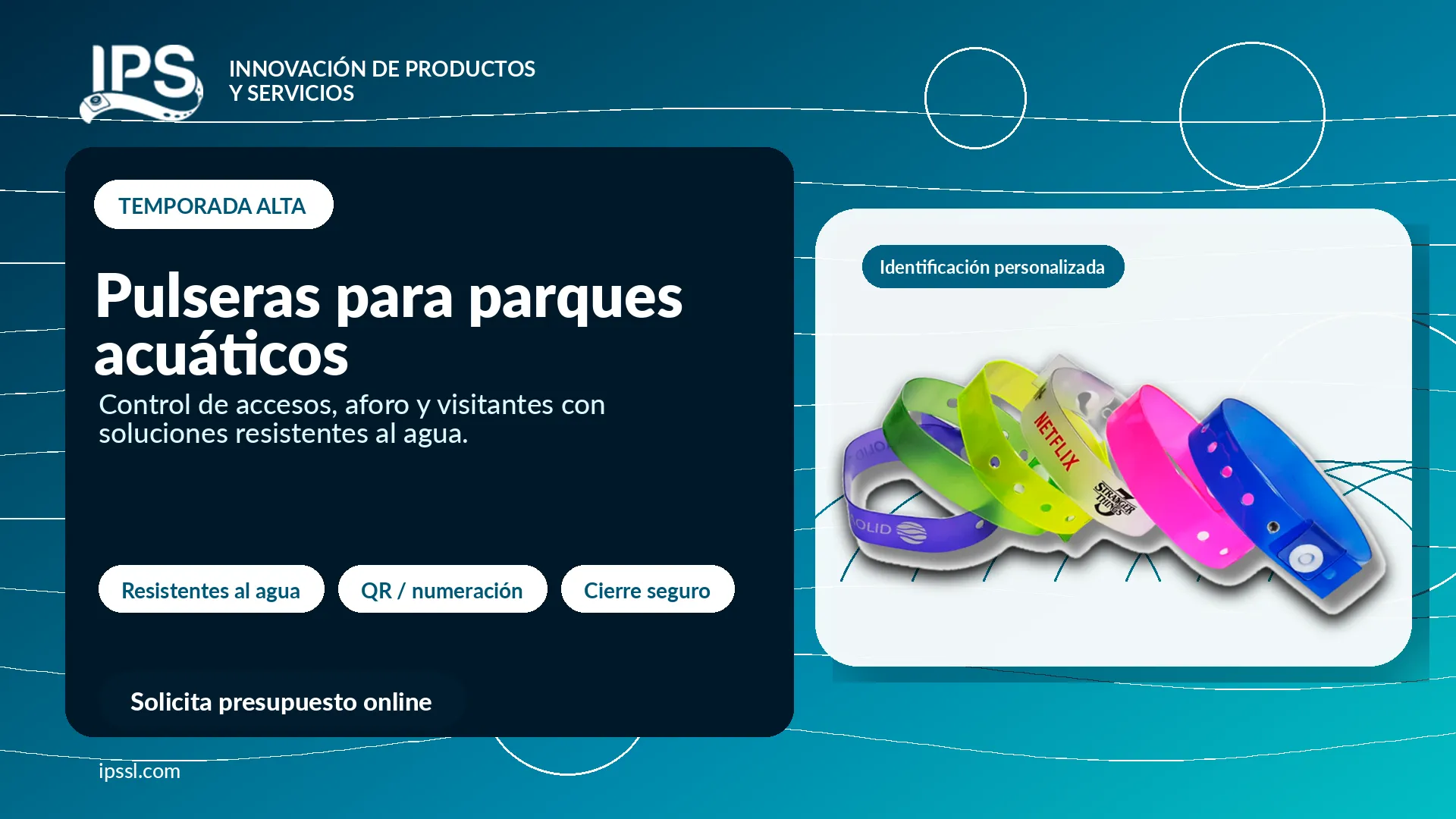
It offers greater resistance, works especially well in water environments and better withstands continuous use in pools, spas or campsites.
It does not aim to stand out visually, but it does offer stability and durability.
And many times that is exactly what the operation needs.
RFID silicone wristbands
Here the approach changes completely.
It is no longer about buying a one-off solution, but about investing in a reusable system prepared for intensive use.
They are durable, comfortable and especially effective in resorts, holiday hotels or establishments where volume quickly amortises the initial investment.
When the operation is demanding, they usually become the most efficient option in the medium term.
The wristband also communicates
There is an aspect that is often underestimated: the wristband also speaks about the hotel.
An establishment that cares for every detail cannot afford to hand over an element that conveys just the opposite. Just as a hotel committed to sustainability needs consistency in everything that is part of the guest experience.
That is why more and more hotels opt for eco-friendly materials, reusable systems or custom designs that not only fulfil a practical function but also reinforce the brand's positioning.
It is not only a technical decision.
It is a decision of image and consistency.
The most common mistake
If there is one mistake that is constantly repeated, it is this: choosing solely on price.
Without analysing the context, the duration of use, the necessary replacements or the impact it will have on the daily operation.
What is cheap stops being so when it forces constant replacement. And what seems expensive stops seeming so when it pays for itself over years.
The key is not in the price per unit.
It is in the real running cost.
So, how do you make the right decision?
In reality, the answer usually appears when you analyse five very specific questions:
- How long do your guests' stays last?
- How do they use the facilities?
- What image do you want to project?
- How important is sustainability to your brand?
- What investment horizon are you willing to take on?
When those answers are clear, the decision stops being complex.
It becomes something logical.
Conclusion
Choosing the right wristband for a hotel is no minor matter.
It is a strategic decision that directly affects operations, costs and the experience the guest receives.
And, as with many things in hospitality, the seemingly small details are the ones that end up making the difference.
At IPS we work precisely on that point: first understanding how each establishment works before proposing a solution.
Because it's not about selling a wristband.
It's about finding the one that truly fits your hotel.
Do you need a personalised recommendation?
Every hotel has different needs. We analyse your operation, the type of guest and the real use of the system to help you choose the most suitable solution.
Request a personalised recommendation here.